
A Spelling Bee solver takes the seven letters from any or today's spelling bee hive and returns every dictionary word that is at least 4 letters long, contains the center letter, and uses only the seven given letters, which may repeat. Words using all seven letters at least once are pangrams and score a 7-point bonus.
Enter the center letter into the highlighted yellow cell, this letter is required in every valid word.
Enter the six outer letters from today's hive into the remaining cells, in any order.
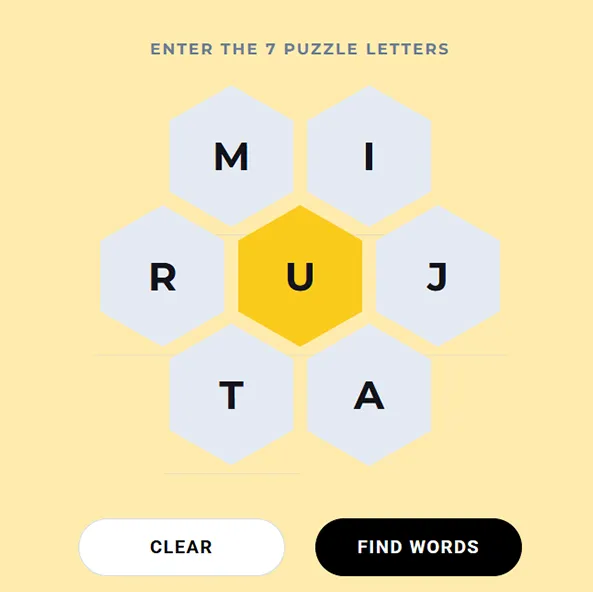
Press Find Words. The solver checks the full dictionary and returns every word that fits, grouped by length, with pangrams highlighted.
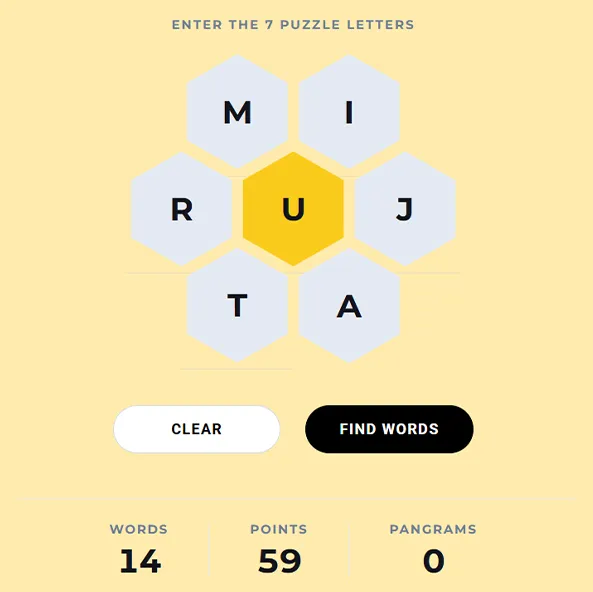
If you're a few words short of Genius or chasing the Queen Bee crown, the tool above solves today's Spelling Bee puzzle instantly, enter your seven letters and it returns the full valid word list, sorted by length, with every pangram marked. It's free to use, works for both the daily puzzle and SpellBees Unlimited mode, and doesn't sit behind a login, a Patreon paywall, or an account signup, unlike several other solver tools.
This page also explains exactly how a Spelling Bee solver works under the hood, what separates it from a general anagram solver, manual strategies for finding words without a tool at all, the mistakes that cost players points, and a full breakdown of scoring, ranks, and rules, so you can use the solver as much or as little as you want.
The Spelling Bee resets with a new set of seven letters at 3:00 AM Eastern Time each day, so a solver built around fixed answers goes stale within 24 hours. This tool sidesteps that entirely: instead of publishing a daily answer list that needs manual updates, it solves whatever seven letters you type in, which means it works identically for today's puzzle, yesterday's, an archived puzzle from months ago, or a fresh set generated by Spelling Bee Unlimited. There's nothing to check for "today's update", the solver is only ever as current as the letters you give it.
A Spelling Bee solver works by filtering a dictionary word list against three constraints at once, rather than rearranging letters like a typical anagram tool. When you submit your seven letters, the solver runs each candidate word in its dictionary through three checks:
Any word that passes all three is a valid answer. Because letters can repeat, this is fundamentally different from a classic anagram solver, which typically treats each letter as a single-use tile and can't handle a word like "level" or "peppy" that reuses letters far more than once. That distinction is also why a plain anagram solver will under-report results if you try to use one for Spelling Bee, it wasn't built for a repeat-letter, subset-based puzzle.
Once the valid word list is built, the solver checks each word against the full seven-letter set again to flag pangrams, then applies the scoring formula below to calculate point totals.
| Word type | Points |
|---|---|
| 4-letter word | 1 point |
| 5+ letter word | 1 point per letter |
| Pangram (uses all 7 letters) | Word's normal score + 7 bonus points |
Most daily puzzles include at least one pangram. Reaching "Genius" typically takes roughly 70% of the day's total possible points; finding every valid word earns the Queen Bee title.
Because the solver searches a broad English word list, it can occasionally surface a word NYT's official answer key excludes, usually a proper noun, an obscure entry, or a word the puzzle's editors ruled out by hand. If the game rejects a word the solver suggested, that's a list mismatch, not a bug in your play.
The fastest manual approach is to build words outward from the center letter using common English prefixes and suffixes, rather than scanning the letters randomly. A few techniques from our spelling bee practice tips guide that consistently find words faster than trial and error:
Both approaches are valid depending on what you want out of the puzzle, a quick answer or the mental workout.
| Approach | Best for | Trade-off |
|---|---|---|
| Solving manually | Vocabulary building, daily mental exercise, the intended game experience | Slower; easy to miss valid words, especially ones with repeated letters |
| Using the solver for hints only | Getting unstuck on one last word for Genius without seeing everything | Requires self-discipline to stop scrolling once you've found what you needed |
| Using the solver for the full list | Confirming Queen Bee, settling a dispute over a rejected word, or when you're short on time | Removes the challenge if used before attempting the puzzle |
If you want a lighter touch than the full list above, SpellBees' spelling bee hints page help gradually instead of all at once.
A word that uses all seven letters of the puzzle at least once. Worth a 7-point bonus on top of its normal score.
The honeycomb-shaped grid of seven letter cells, one center cell surrounded by six outer cells, that makes up the puzzle layout.
A scoring rank reached at a set percentage of that day's total possible points. The exact percentage NYT uses for each rank threshold is not published as a fixed constant, so treat published percentage figures as approximate.
The top rank, earned only by finding every single valid word in that day's puzzle, including the pangram.
A Spelling Bee solver is a constraint-based dictionary filter, not a simple anagram tool: it checks every word for the 4-letter minimum, the required center letter, and the seven-letter alphabet limit, then flags pangrams and totals the score. Use the tool above for an instant full answer list, or use the strategies in this guide, pangram-first scanning, suffix testing, and double-letter checks, to close the gap yourself before you check.
Enter the center letter and the six outer letters from today's hive into the solver above and press Find Words. The tool returns every valid word for that letter set, grouped by length, with pangrams highlighted.
A pangram is any word that uses all seven letters from the hive at least once. Pangrams score seven bonus points on top of the word's normal length-based score, and most daily puzzles contain at least one.
Yes. Enter any seven letters, including ones generated by SpellBees Unlimited mode, and the solver returns every valid word for that set.
The solver checks against a broad English word list, while NYT's official answer key excludes proper nouns, hyphenated words, and a small number of obscure or offensive entries. Treat a rejected word as a list mismatch, not an error in your play.
Yes. Any of the seven letters, including the center letter, can be reused as many times as needed within a single word.
It depends on how it's used. Checking a solver after genuinely attempting the puzzle, or using it to confirm a word you already found, is common practice. Pasting the full answer list before trying at all skips the part of the game that builds vocabulary and pattern recognition.
A general anagram solver rearranges a fixed set of letters into words using each letter once. A Spelling Bee solver is a constraint-based word finder: it allows letter repetition, requires the center letter in every result, and enforces a 4-letter minimum, logic a standard anagram tool isn't built to handle.
The maximum score changes every day because it depends on how many valid words exist for that day's specific seven letters. There's no fixed maximum across all puzzles, reaching 100% of that day's total is the Queen Bee rank.
No. NYT's official Spelling Bee excludes proper nouns, along with hyphenated words, words with apostrophes, and a small set of obscure or offensive entries, even if a general dictionary or solver would otherwise accept them.