Here's the short answer before we go deep: a spelling bee pangram is any word that uses all seven hive letters at least once, including the center letter. Every NYT Spelling Bee puzzle is guaranteed to contain at least one. Finding it is partly vocabulary, partly pattern recognition, and both get better with practice.
This guide covers exactly what a pangram is, how the scoring actually works (with real numbers), the difference between a pangram, a perfect pangram, and a bingo, and a three-step strategy for finding the pangram faster without immediately reaching for a solver.
What Is a Pangram in Spelling Bee?
In the NYT Spelling Bee, a pangram is a word that uses all seven letters in the puzzle's honeycomb hive at least once. The center letter must be included, which is already a requirement for every valid word in the game, but in a pangram, all six outer letters appear in the same word too. Letters can repeat; what matters is that all seven unique letters show up at least once.
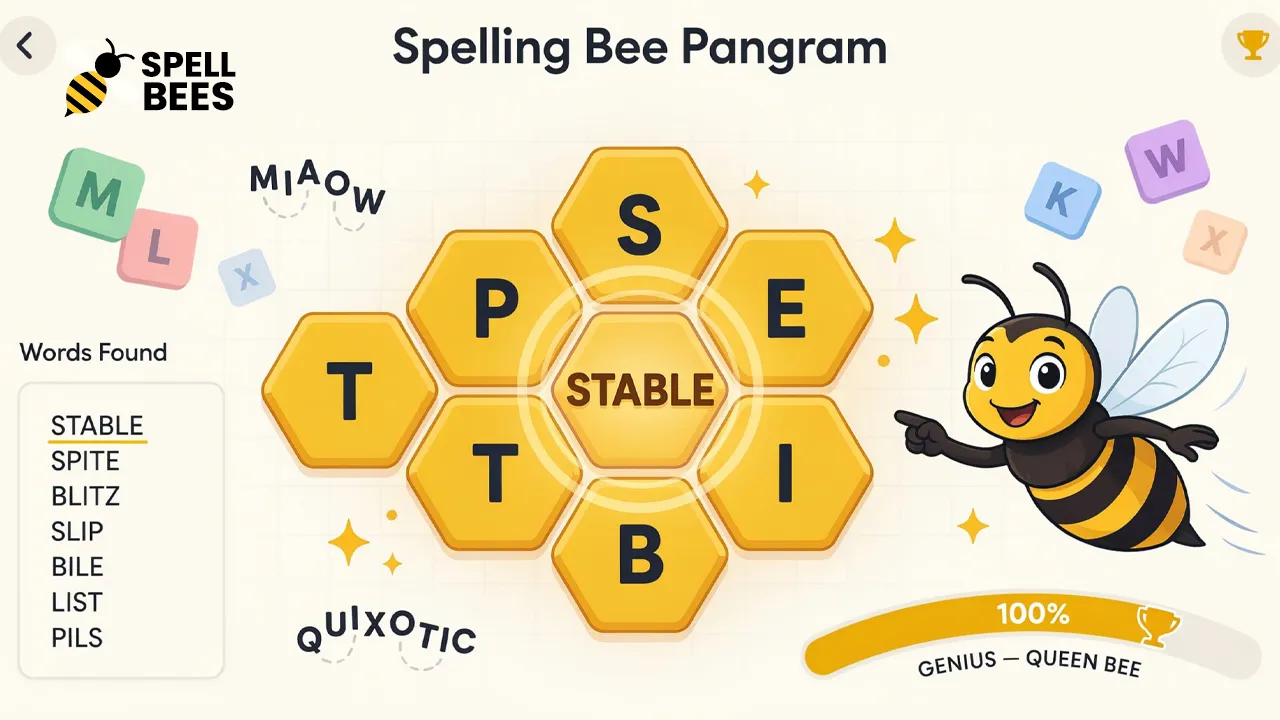
When you enter a pangram, the game confirms it with a visual signal, a golden shimmer animation on the NYT version. You also hear an extra chime. It's the most satisfying moment the game offers, and it's designed to feel that way. You can visit spellbees.us for today's pangram.
Pangram vs. Perfect Pangram: What's the Difference?
A standard pangram allows letter repetition. A perfect pangram doesn't, each of the seven hive letters appears exactly once, no more. Because English words rarely use seven distinct letters with no repeats, perfect pangrams are uncommon in the NYT Spelling Bee. They appear roughly once every few weeks. Finding one without any hints is the closest thing the game has to a "hidden achievement."
| Feature | Standard Pangram | Perfect Pangram | Bingo |
|---|---|---|---|
| What it requires | One word using all 7 letters at least once | One word using each of the 7 letters exactly once | At least one valid word starting with each of the 7 letters |
| Letters can repeat? | Yes | No | N/A, it's multiple words |
| How common? | Every puzzle has at least one | Rare, roughly once every few weeks | Achievable in most puzzles with effort |
| Bonus awarded? | +7 points on top of word score | +7 points (same bonus) | No point bonus, it's a separate achievement tracker |
| Can you get one without the other? | Yes, you can find the pangram without achieving bingo | Yes | Yes, bingo doesn't require finding the pangram |
Is There Always a Pangram in the NYT Spelling Bee?
Yes, every NYT Spelling Bee puzzle is guaranteed to contain at least one pangram. This isn't a coincidence. The puzzle is designed around the pangram word. NYT editors choose the seven hive letters specifically to ensure a valid pangram exists first, then build the rest of the word list around those letters. The pangram is the architectural foundation of each daily puzzle, not an afterthought.
Some puzzles contain two pangrams. A handful contain three. A perfect pangram (where each letter appears exactly once) is rarer and appears occasionally, but the standard at-least-one-pangram guarantee holds for every single daily puzzle.
One more note worth flagging: some competing sites claim pangrams aren't guaranteed in every puzzle. That's incorrect for the NYT Spelling Bee specifically. Every daily hive has one.
Spelling Bee Pangram Rules
A word qualifies as a pangram if it meets all of the following conditions. There are no exceptions:
- ➥The word must contain all seven hive letters, the center letter plus all six outer letters.
- ➥The center letter must appear (this applies to every valid word in the game, pangram or not).
- ➥Letters may repeat. Using one of the seven letters three times in a word still counts, as long as all seven unique letters appear somewhere in the word.
- ➥The word must be at least four letters long, the standard minimum for all Spelling Bee words.
- ➥No proper nouns, hyphenated words, or obscene words. Standard Spelling Bee word rules apply.
- ➥A perfect pangram additionally requires each letter to appear exactly once, with no repetitions at all.
How Pangram Scoring Works (With Real Numbers)
This is the section most pangram guides skip, and honestly that's frustrating, because the math is simple and understanding it changes how you prioritize your gameplay.
Here's how Spelling Bee scoring works in full:
- ➥A 4-letter word = 1 point (flat)
- ➥A word of 5+ letters = 1 point per letter
- ➥A pangram of any length = the word's regular score plus 7 bonus points
| Pangram Length | Base Score | Pangram Bonus | Total Score |
|---|---|---|---|
| 7 letters (minimum) | 7 points | +7 points | 14 points |
| 8 letters | 8 points | +7 points | 15 points |
| 9 letters | 9 points | +7 points | 16 points |
| 10 letters | 10 points | +7 points | 17 points |
To put that in perspective: a 7-letter pangram scores as much as finding fourteen separate 4-letter words. One word. Same points. This is why experienced players prioritize the pangram hunt above almost everything else once they've collected their first ten or so words.
Spelling Bee Pangram Hints - How to Get Help Without Spoiling It
There's a spectrum between "figure it out yourself" and "look up the full answer." Most players want something in the middle, enough of a nudge to get unstuck without handing over the satisfaction of discovery. Here's a tiered hint system, from least to most revealing:
Hint Level 1 - First Letter
Work through each of the seven hive letters as a potential starting letter. For each one, mentally ask: "Could this be the first letter of a word that also uses all six remaining letters?" Most players find the pangram within five to ten minutes using just this approach. It sounds simple, but it forces your brain to actively build outward rather than passively scanning.
Hint Level 2 - Letter Count
Most NYT Spelling Bee pangrams land between 7 and 9 letters long. If the puzzle has a perfect pangram (all 7 letters used exactly once), it's exactly 7 letters. If letters repeat, it's 8 or more. Knowing the approximate length narrows the search considerably, you can stop testing 12-letter possibilities and focus on a tighter range.
Hint Level 3 - Pattern Hints
Certain word structures produce pangrams more often than others, because they naturally incorporate a wide variety of distinct letters. If you're stuck, test whether the hive letters can form words with these endings or structures:
- ➥-TION / -ATION: words like "location" or "notation" use many distinct letters
- ➥-MENT: combined with a rich stem, often lands on 7+ unique letters
- ➥RE- / UN- prefixes: add two distinct letters and open up longer root combinations
- ➥-LING / -NESS : less common but occasionally produce pangrams in the right hive
Hint Level 4 -Community Hints for NYT
For today's specific NYT Spelling Bee pangram, the NYT Wordplay blog and the Beehaw community both publish a first-letter hint by around 8 AM Eastern each morning, followed by progressively fuller reveals through the day. These are spoiler-graded, so you can stop reading at whatever reveal level you're comfortable with.
Hint Level 5 -Unlimited Practice
The honest truth about "hints" is that the best one is more reps. The more puzzles you complete, the faster you recognize pangram-shaped words. Our Unlimited Spelling Bee mode gives you exactly that, an unlimited supply of free puzzles with no daily cap, each one containing at least one pangram. Practice here and you'll rely on hint systems less and less.
How to Find the Spelling Bee Pangram - A 3-Step Strategy
Most experienced players land on the pangram within steps 1 or 2 below. Step 3 is for when the first two genuinely don't work, not as a default.
Step 1 - Shuffle, Then Shuffle Again
The shuffle button isn't just for decoration. When letters move to new positions, your brain sees different adjacencies and your pattern recognition fires differently. Seriously, shuffle at least three times before concluding you're stuck. It costs nothing and regularly surfaces pangrams that were invisible a moment earlier. We've seen players find the pangram on the third shuffle after spending fifteen minutes staring at the same arrangement.
Step 2 - Hunt Prefixes and Suffixes First
Look at which letters in the hive could form a common prefix or suffix, then try building the rest of the word around them. This is faster than trying to build a pangram from scratch because prefixes and suffixes anchor your thinking. If you have an R, E, and a vowel, ask: "What RE- words could use the remaining four letters?" If you have T, I, O, N, ask: "What roots end in -TION that also need these other three letters?"
Step 3 - Expand From Words You've Already Found
Look at the words you've already entered. Pick any word that's 4-5 letters long and check which of the seven hive letters it doesn't contain. Then ask: "Could adding those missing letters to this word, either before it, after it, or embedded in it, create a longer valid word?" Many pangrams share roots with shorter words already in the puzzle. This is the most methodical approach and works particularly well in puzzles where you've already found fifteen or more words but still can't spot the pangram.
For vocabulary building that helps you recognize more valid pangram candidates, our Spelling Bee Words by Grade guide is worth a read, it's particularly useful if you're building your range of longer, less common words that tend to show up as pangrams.
Common Spelling Bee Pangram Word Patterns
The specific pangram changes every day, so memorizing individual answers helps very little. What's actually useful is knowing which word structures tend to produce pangrams, because those patterns repeat across different letter sets.
Across a full year of NYT Spelling Bee puzzles, pangrams tend to cluster around words that:
- ➥End in -TION, -ATION, or -ATION : these suffixes alone contribute four to five distinct letters
- ➥Use the prefix RE- or UN- combined with a long root
- ➥Are compound-style words where two recognizable roots join ,compound words naturally draw from two separate letter pools, which helps hit all seven unique letters
- ➥End in -MENT combined with a rich stem (e.g., words like "movement" or "alignment" when the letters allow it)
- ➥Are gerunds (-ING words) built on 5-letter roots ,because -ING adds three letters, pushing you toward 8+ letters with broader coverage
None of this tells you what today's pangram is. But it gives you a mental filter: when you're scanning possibilities, these structures are where your attention should go first. More on building these word instincts in our Spelling Bee Practice Tips guide.
Spelling Bee Bingo vs. Pangram - They're Not the Same Thing
These two get confused constantly, and it's understandable, both involve "using all the letters." But they're completely separate achievements:
- ➥ Spelling Bee Pangram: A single word that uses all 7 hive letters at least once. It's a word-level achievement. One word, one moment, done.
- ➥ Spelling Bee Bingo: A puzzle-level achievement where you find at least one valid word that starts with each of the 7 letters. It requires seven separate words, one per letter, and tracks your coverage across the full word list.
You can absolutely find the pangram without achieving bingo. You can also achieve bingo without ever finding the pangram (though bingo becomes much easier if you've found the pangram, since it guarantees one starting letter is covered). The pangram gives a bigger individual score boost. Bingo is more of a completionist badge. Both contribute to your rank, but they're measuring different things.
Pangrams Beyond the Spelling Bee: What the Word Actually Means
Outside of the NYT Spelling Bee, the word "pangram" traditionally refers to a sentence that uses every letter of the alphabet at least once. The most famous English example, "The quick brown fox jumps over the lazy dog", has been used for over a century to test typewriters, fonts, and keyboards, precisely because it covers all 26 letters.
In the Spelling Bee context, though, a pangram is something different: a single word (not a sentence) that uses all seven hive letters. The scope is narrower but the challenge is arguably harder, since you're working within a constrained letter set and building a real, dictionary-valid word from it.
Other languages have their own pangram traditions. German uses "Victor jagt zwölf Boxkämpfer quer über den großen Sylter Deich" as a common pangram sentence. French has "Voyez le brick géant que j'examine près du wharf." The underlying concept, use every available letter in one construction, is universal across writing systems.
Where to Practice Finding Pangrams for Free
The NYT Spelling Bee gives you one puzzle per day. That's enough to stay in the habit, but it's genuinely not enough reps to get faster at finding pangrams. One puzzle a day means one pangram a day, and if you get stuck and look it up, you've learned almost nothing about how to find the next one.
Our Unlimited Spelling Bee mode is free, has no daily limit, and every puzzle contains at least one pangram. Play five or ten puzzles in a session and you'll start to notice your pangram-spotting improving in real time. There's no paywall, no account required, and no daily reset to wait for.
If you're just starting out and want to understand the full game mechanics before hunting pangrams, start with our How to Play Spelling Bee guide first, then come back here when you're ready to go deeper on pangram strategy.
Why Finding a Pangram Feels Different From Every Other Word
It's not just the points. Something genuinely different happens when you find a pangram, and it's worth naming, because it explains why the game is designed around this moment.
Most word-finding is additive, you find a word, add it to your list, keep going. The pangram breaks that pattern. When it appears, everything stops briefly. The animation plays, the sound changes, and your rank often jumps visibly. It's the game's way of marking a real achievement, not just an incremental one.
There's also something specific to the constraint. Finding a word in Spelling Bee usually feels like recognition, you spot something you already know. Finding the pangram feels more like construction. You're not just remembering a word; you're discovering that a particular combination of these specific seven letters can form something real. That's a different cognitive experience, and it's why players remember specific pangrams they've found long after they've forgotten everything else about that day's puzzle.
Final Thoughts
The spelling bee pangram isn't just a bonus word. It's the word each puzzle is built around. Every other valid answer in the hive exists because the editors found the pangram first and filled in around it.
Understanding that changes how you approach the game. The pangram isn't hiding, it's the foundation. Your job isn't to stumble across it; it's to reverse-engineer the structure of the puzzle until you see what the editors started with.
Use the three-step approach: shuffle first, hunt prefixes and suffixes second, and expand from words you've already found third. If you want to build your pangram instincts faster, play unlimited free puzzles at SpellBees.us, each one has at least one pangram, there's no daily limit, and it costs nothing. The pangram is waiting. You're usually one shuffle away from seeing it.