
To begin the free spelling bee daily game, you must identify the first word by using the seven letters from the hive. The rules of the game are that every word must have a center letter and a minimum of four letters. Keep in mind that the same letter might be used more than once.
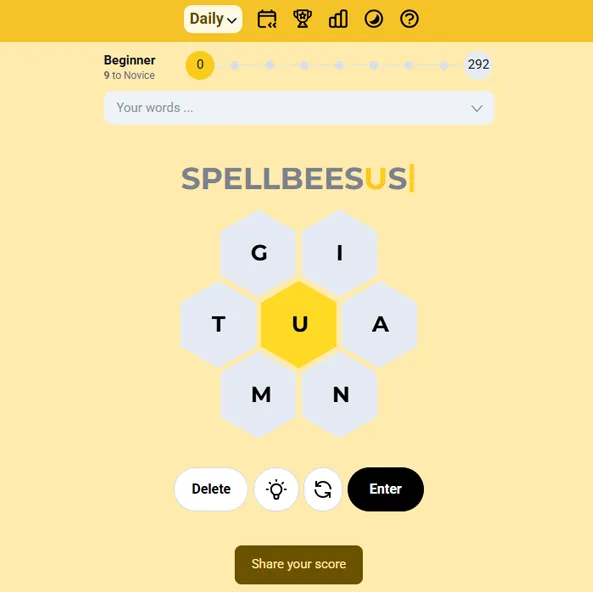
Each word you found will contribute to your final score. Four-letter words receive an additional point. A longer term is worth one point for each letter. Finding a pangram also earns you seven more points! The goal of the game is to score as many points as you can. Remember that if you encounter difficulties, you can rearrange the letters.
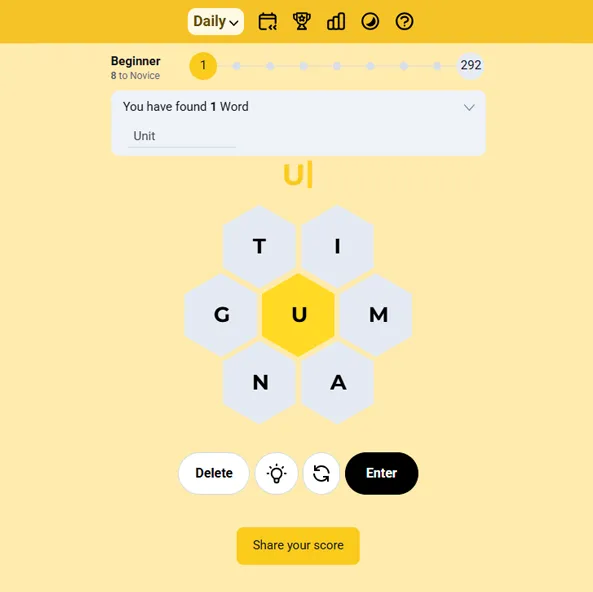
Keep an eye on your score you achieved and always aim for the highest score . There will be given levels to you as you will move advance in the free spelling bee game. As you will find out all words and achieve highest score then you will get the "Genius" level. You can visit daily with a new challenge for you.
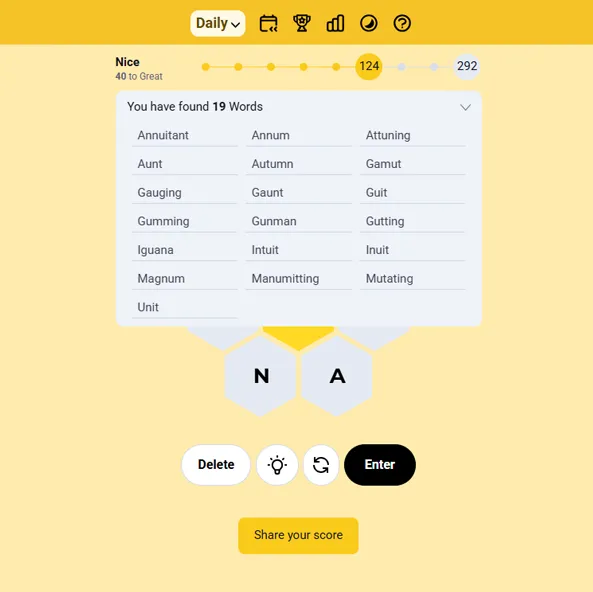
If you leave the game, your progress will be saved so you can continue later. You can also review yesterday’s game answers to learn and improve. Enjoy the experience and keep playing daily for a new challenge.
Word games come and go, but few have managed to combine challenge, learning, and pure satisfaction the way Spelling Bee Daily does. At first glance, it looks simple: seven letters arranged in a honeycomb, one required center letter, and a mission to form as many valid words as possible. Yet anyone who has spent time with the Spelling Bee game knows that beneath this clean design lies a surprisingly deep test of vocabulary, logic, and mental agility.
Whether you’re playing casually to unwind, sharpening your skills for competitive spelling bees, or using word puzzles as a way to improve memory and language fluency, Spelling Bee Daily offers far more than just entertainment. It trains the brain, strengthens spelling intuition, and encourages creative word formation, all while keeping the experience engaging and rewarding.
In this guide, we’ll explore how the Spelling Bee free game works, why it’s so effective as a learning tool, how scoring and pangrams influence strategy, and how daily practice can dramatically improve vocabulary, focus, and confidence with words.
The Spelling Bee game is a word puzzle built around a simple but powerful concept. Players are presented with a set of seven letters, arranged in a honeycomb structure, with one letter placed at the center. Using these letters, players must create words that meet a few clear rules:
This structure forces players to think beyond obvious combinations. You’re not just recalling words, you’re actively building them, testing patterns, prefixes, suffixes, and linguistic instincts along the way.
Spelling Bee Daily refreshes the puzzle every 24 hours, making it a habit-forming challenge that keeps your mind sharp without feeling repetitive.
Each day, Spelling Bee Daily presents a fresh hive of letters. Your first task is to identify a valid starting word. This often feels harder than expected because the center letter requirement limits your options. However, once you unlock a few initial words, patterns begin to emerge, and momentum builds naturally.
The shuffle button plays a surprisingly important role here. Shuffling the hive rearranges the letters visually, helping you notice combinations that might not stand out in a fixed layout. Many experienced players rely on shuffling to break mental blocks and spark new ideas.
As you find words, they are added to your word list, contributing to your overall score. The challenge lies not just in finding many words, but in identifying longer and more complex ones.
Every Spelling Bee puzzle guarantees at least one pangram, but spotting it requires flexible thinking and strong vocabulary awareness. Pangrams often separate casual players from advanced ones.
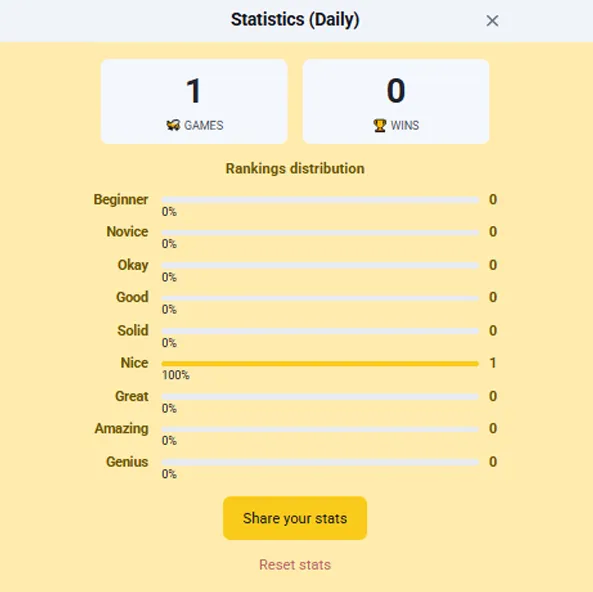
Spelling Bee Daily doesn’t just count points, it tracks progress through levels. As your score increases, you move through stages that reflect your mastery of the puzzle. Reaching the “Genius” level is considered a major milestone and a clear sign of strong word-building skills.
This layered progression system keeps the game motivating. You’re not just playing to pass time, you’re actively working toward a measurable achievement.
The brilliance of the Spelling Bee Daily format lies in how it balances difficulty and reward. The rules are easy to understand, but mastering the puzzle takes time. Each discovery feels earned, especially when you unlock a longer word or finally uncover the pangram.
Unlike fast-paced games that rely on reflexes, the Spelling Bee game rewards thinking, patience, and linguistic intuition. It creates a flow state where minutes, or even hours, can pass unnoticed as you chase that next high-value word.
One of the most powerful benefits of Spelling Bee Daily is its effect on vocabulary building. Each puzzle exposes players to new word structures, unusual letter pairings, and less common terms that still fall within standard dictionaries.
Over time, players naturally develop:
This mirrors the preparation methods used in competitive spelling bees, where contestants study word lists, analyze etymology, and practice recall under pressure.
Repeated exposure to word patterns improves long-term memory. Players become faster at recalling valid words and recognizing letter combinations that work.
The puzzle demands sustained attention. You can’t brute-force your way through it, you must slow down, think carefully, and stay engaged.
Every puzzle is a small logic problem. You’re constantly evaluating possibilities, testing hypotheses, and learning from mistakes.
Many players describe Spelling Bee Daily as a form of mental warm-up. Like stretching before exercise, it prepares the brain for more demanding tasks throughout the day.
Pangrams are the crown jewels of the Spelling Bee game. Because they use every letter in the hive, they offer the biggest point boost and often unlock new thinking pathways.
Experienced players often hunt for pangrams early, not just for the points, but because pangrams reveal how the letter set wants to be used. Once you find one, other words tend to fall into place more easily.
A good strategy is to:
Word games like Wordle, Quordle, Dordle, Octordle, and Sedecordle have surged in popularity, each offering a unique spin on language puzzles. However, Spelling Bee Daily stands apart in several ways.
| Feature | Spelling Bee Daily | Other Word Games |
|---|---|---|
| Focus | Word creation | Word guessing |
| Replay Value | Daily + unlimited | Limited |
| Skill Development | Vocabulary, memory, spelling | Pattern recognition |
| Difficulty Curve | Player-driven | Fixed |
While guessing games reward deduction, the Spelling Bee game rewards creative construction, making it particularly effective for long-term language improvement.
For players who want more than the daily puzzle, Spelling Bee Unlimited mode offers endless practice. This is especially useful for students preparing for spelling competitions or adults looking to seriously expand their vocabulary.
Spelling Bee Daily can also be played socially. By sharing game links, friends can compete using the same letter set, comparing scores and word lists. This turns a solo activity into a friendly challenge, and often leads to discovering words you might never have found alone.
The skills developed through Spelling Bee Daily closely mirror those required in traditional spelling bee competitions, including the Scripps National Spelling Bee.
Competitive spelling bees test:
Daily word puzzles help reinforce these abilities in a low-stress environment. Many students and educators use spelling games as supplements to formal study lists, flashcards, and mock spelling bees.
To get better at Spelling Bee Daily, and spelling in general, players often adopt strategies used by competitive spellers:
Over time, these habits compound, leading to noticeable improvements in spelling accuracy and confidence.
Occasionally, players find a word they’re certain is valid, only to see it rejected. This usually happens because the word falls outside the game’s accepted database. Proper nouns, archaic terms, and extremely obscure words are often excluded to keep gameplay fair and accessible.
Spelling Bee Daily allows players to submit feedback on missing words, helping improve the experience over time.
Although spelling bees are traditionally associated with students aged 8 to 15, the Spelling Bee Daily format appeals to all age groups. Adults use it as brain training, students use it to support academic growth, and educators incorporate it into classrooms as a fun learning tool.
Winning a competition is exciting, but the real reward is long-term language mastery.
Spelling Bee Daily succeeds because it respects the player’s intelligence. It doesn’t rush you, distract you, or overwhelm you with noise. Instead, it presents a clear challenge and lets curiosity do the rest.
Each puzzle feels fair but demanding. Each word found reinforces learning. Each missed word becomes an opportunity for growth. This balance is what keeps players coming back, not out of obligation, but genuine enjoyment.
Spelling Bee Daily is more than a word game. It’s a daily exercise in creativity, discipline, and linguistic exploration. By combining simple rules with deep complexity, it transforms spelling practice into something engaging, rewarding, and genuinely fun.
Whether you’re chasing the Genius level, preparing for a competitive spelling bee, or just looking to keep your mind sharp, the Free Spelling Bee game offers a proven path to better vocabulary, stronger memory, and greater confidence with words.
And the best part? There’s a new challenge waiting for you tomorrow.
Spelling Bee Daily is a word puzzle game where players create valid words using seven letters, including one required center letter, to score points and improve vocabulary.
Players form words of at least four letters using the given letters. Every word must include the center letter, and letters can be reused multiple times.
The puzzle updates every 24 hours, giving players a brand-new letter set and challenge each day.
A pangram is a word that uses all seven letters in the puzzle at least once and awards bonus points when found.
Four-letter words earn 1 point, longer words earn one point per letter, and pangrams give an extra 7 bonus points.
Words may be rejected if they are proper nouns, overly obscure, archaic, vulgar, or not included in the game’s dictionary.
The Genius level represents a high mastery score, showing advanced vocabulary skills and strong word-building ability.
Yes, daily play improves spelling, memory, word recognition, and understanding of prefixes, suffixes, and word roots.
Many versions offer an unlimited mode, allowing players to practice endlessly beyond the daily challenge.
Spelling Bee Daily focuses on creating words rather than guessing them, offering deeper vocabulary development and higher replay value.