What Is the Spelling Bee Game?
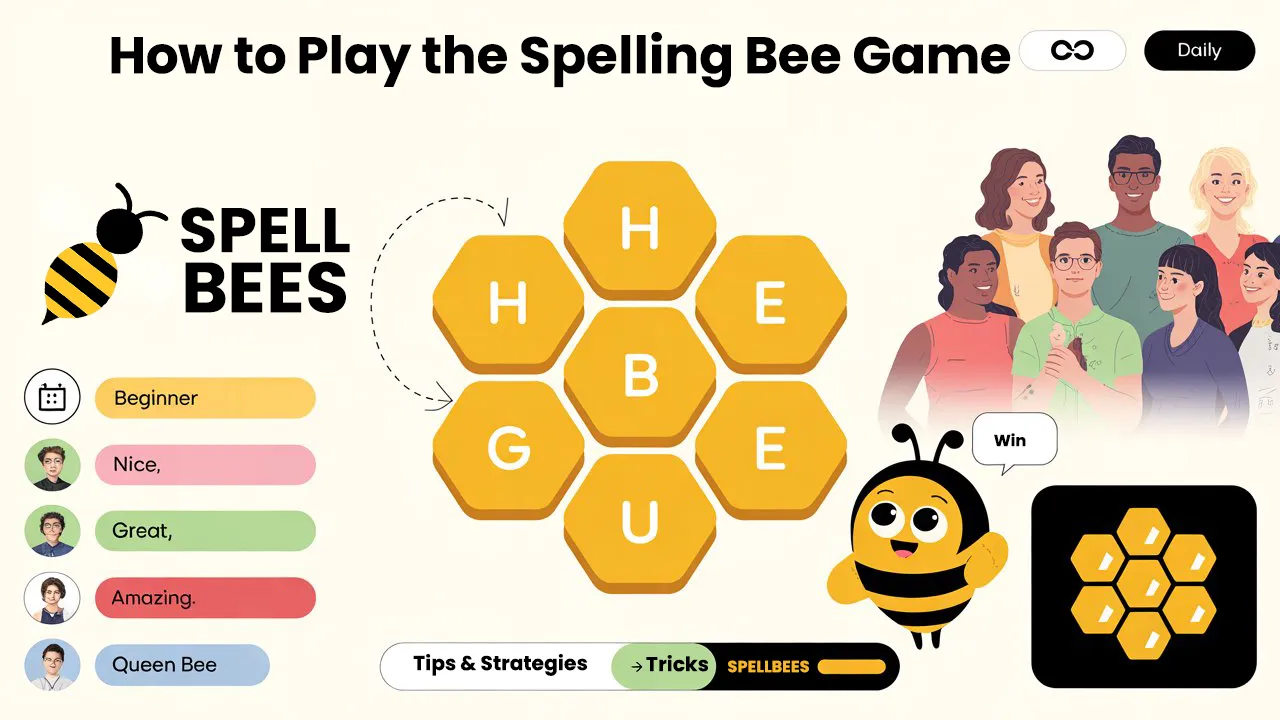
Spelling Bee is a word-building puzzle played on a hexagonal grid of seven letters. One letter sits in the center; the other six surround it. Your job is to find every valid word hidden in those letters, with one rule that makes everything harder: the center letter must appear in every word you form.
The game was popularized by the New York Times, but you don't need an NYT subscription to play. The only difference between us and the NYT version is that NYT locks most play behind a paid subscription. We don't.
It's not a vocabulary test disguised as a game. It's a pattern-recognition puzzle disguised as a vocabulary test. The letters don't change. The words are always there. The challenge is training your brain to see them. If you want to explore words organized by learning level, our Spelling Bee Words by Grade guide is a good starting point.
Spelling Bee Game Rules - Exactly How It Works
The rules are simple on paper. They become less obvious the first time the game rejects a word you were confident about.
- ➥Minimum four letters. Two- and three-letter words don't count, no matter how common they are.
- ➥Center letter in every word. This is non-negotiable. A word built only from the outer six letters gets rejected every time.
- ➥Letters can repeat. You can use any letter more than once within a single word. "TATTOO" from a puzzle containing T, A, and O is fair game.
- ➥No proper nouns. Names of people, places, and brands are not accepted.
- ➥No hyphenated words or obscene language. The word list follows standard dictionary rules.
- ➥The letter "S" is excluded. Every puzzle deliberately leaves out S to prevent players from simply pluralizing everything they find. It's one small rule that radically increases difficulty.
- ➥Pangram bonus. Any word that uses all seven letters earns a 7-point bonus on top of its normal score. These are rare and worth hunting for.
How Does Scoring Work in Spelling Bee?
This is where a lot of players go wrong. The rank thresholds are percentages of the day's maximum possible score, not fixed numbers. But the per-word scoring is fixed:
- ➥4-letter words = 1 point each
- ➥5-letter words = 5 points
- ➥6-letter words = 6 points (1 point per letter)
- ➥7-letter words = 7 points
- ➥8-letter words = 8 points, and so on
- ➥Pangrams = word length points + 7 bonus points
- ➥Genius rank = roughly 70% of the day's maximum possible score
That 4-letter scoring quirk trips people up. Four-letter words score 1 point regardless of how long they feel, same as any other 4-letter word. Once you hit five letters, points scale with length. This means longer words are dramatically more efficient. A 9-letter pangram can score 16 points in one go.
All Spelling Bee Ranks - What Each One Means
Ranks are based on your percentage of the total possible points for that puzzle. The actual point thresholds shift every day depending on the puzzle. Here are the eight levels you'll move through:
| Rank | % of Max Score | What It Feels Like |
|---|---|---|
| Beginner | 0–4% | You've just started |
| Good | 5–14% | You're finding the easy words |
| Solid | 15–29% | Comfortable with the letter set |
| Nice | 30–44% | Spotting word families and patterns |
| Great | 45–59% | You've probably found the pangram |
| Amazing | 60–79% | Few words left; they're the hard ones |
| Genius | 80–99% | The goal most serious players aim for |
| Queen Bee | 100% | Every valid word found, nothing left |
Most dedicated players aim for Genius daily and treat Queen Bee as a bonus rather than a daily expectation. Some puzzles have 40 words; others have over 70. Queen Bee on a 70-word puzzle is a different challenge entirely.
Daily Mode vs Unlimited Mode - Which Should You Play?
This is the question that doesn't come up enough. The two modes serve completely different purposes, and switching between them based on what you need makes a real difference.
Daily Mode
The Daily puzzle resets at midnight. Everyone playing that day works with the same seven letters, which is why the Hive Mind community discussions feel so immediate. You're all stuck on the same words. The puzzle is curated, so letter sets tend to be interesting: plenty of long words, usually a satisfying pangram, and a difficulty level that rewards patience.
Daily mode is best when you want a focused, complete challenge with a definite endpoint. The word list is fixed. You either find them all or you don't.
Unlimited Mode
Unlimited mode generates fresh puzzles continuously. Finish one, start another. There's no reset timer, no shared community puzzle, and no "today's" context, just a steady stream of new letter combinations whenever you want them.
This mode is genuinely valuable for practice. It exposes you to more letter combinations than you'd ever see in daily play alone, and it's where most improvement actually happens. If you're stuck below Amazing on daily puzzles, a week of focused unlimited play tends to break that ceiling.
| Feature | Daily Mode | Unlimited Mode |
|---|---|---|
| New puzzle every | 24 hours (midnight reset) | Instant - play as many as you want |
| Shared with community | Yes, same letters for everyone | No, random per session |
| Best for | Daily challenge, competition feel | Practice, skill building, warmup |
| Subscription needed | Free at spellbees.us | Free at spellbees.us |
| NYT equivalent | NYT daily (paid) | No direct NYT equivalent |
How to Play Spelling Bee for Free (No NYT Subscription Required)
A lot of people land on this page because they want to play Spelling Bee but don't want to pay for a New York Times Games subscription. Here's what your options actually look like:
- ➥spellbees.us (this site recommended): Full Spelling Bee gameplay with no account and no payment. You get the Daily puzzle and Unlimited mode both for free, forever. Same hexagonal hive, same rules, same ranks from Beginner to Queen Bee.
- ➥NYT Spelling Bee free preview: The New York Times lets you see the puzzle interface without a subscription, but you can't submit words or track your rank without paying. It's a preview, not a playable version.
- ➥NYT free trial: New subscribers occasionally get a short trial period for NYT Games. Once it expires, access requires a paid plan.
How to play NYT Spelling Bee without paying: the honest answer is that you can't get the full NYT experience for free long-term. The gameplay rules are identical here at spellbees.us, the hive layout, the center letter rule, the pangram bonus, the rank system. You're not missing the game; you're just playing it at a different address.
How to Play Spelling Bee - Step by Step
- ➥Go to spellbees.us. Choose Daily for today's shared puzzle or Unlimited for instant practice.
- ➥Look at the hive. Find the center letter :it's the one in the middle hexagon. Every word you form must contain it.
- ➥Start with short words. Type any combination of the seven letters, four letters minimum, that includes the center letter. Hit enter.
- ➥Valid words score points and get added to your found-words list. Invalid entries get rejected with no penalty, guess freely.
- ➥Watch your rank bar climb. The progress indicator shows Beginner → Good → Solid → Nice → Great → Amazing → Genius.
- ➥Hunt for the pangram: a word using all seven letters at least once. It gives a 7-point bonus and usually a visual highlight. Most puzzles have exactly one; some have two.
- ➥Use the Shuffle button regularly. A fresh arrangement of the letters triggers different word associations. This isn't cheating, it's mechanics.
- ➥Hit Genius (80%+ of max score) as your daily goal. Then decide whether to push for Queen Bee or move to the next Unlimited puzzle.
Worked Example: Solving a Spelling Bee Puzzle
- ➥Letters: T (center), I, L, N, O, A, C
- ➥First 5 words found: TAIL, TOIL, LINT, COIN, LOIN
- ➥Extending roots: COIL → COILING, ACTION → INACTION
- ➥Pangram hunt: all 7 letters used → TONICALLY (9 letters, 16 pts)
Tools That Actually Help
Three in-game tools make a real difference. Most beginners ignore them. Most experienced players use all three.
- ➥Spelling Bee Buddy: Generates hints based on what you've already found. If you've discovered most 5-letter words but missed some 7-letter ones, the Buddy nudges you toward the gap without just handing you the answer. Use it when you feel genuinely stuck, not as a first move.
- ➥The Grid: A visual map showing how many words exist at each length and starting letter. If the grid shows four 6-letter words starting with "C" and you've found two, you know where to focus. It converts a vague "I've missed something" into a specific search target.
- ➥Past Puzzles: Older puzzles are available for practice. Working through a past puzzle you haven't seen before is one of the fastest ways to build pattern recognition, especially if you check what you missed afterward and study why those words didn't occur to you.
What Is a Pangram and How to Find One Faster
A pangram is a word that uses all seven letters in the puzzle at least once. It earns a flat 7-point bonus on top of its standard per-letter score. A 9-letter pangram, for example, scores 16 points total: 9 for the word length plus 7 for the pangram bonus.
Pangrams tend to be longer words, 7 to 10 letters, because they need to pack in all seven letters. Common approaches to finding them:
- ➥Identify which letters feel underused in your current word list. If you've barely used Q or X, the pangram probably contains them prominently.
- ➥Look for common prefixes that use multiple letters at once: OUT-, ANTI-, INTER-, OVER-, UNDER-. These eat through the letter set quickly.
- ➥Common suffixes work the same way: -ATION, -INGLY, -MENT, -TION. A word like "CAPTIONING" could be a pangram if C, A, P, T, I, O, N are your seven letters.
- ➥If you're close and stuck, use the Shuffle button. The physical rearrangement of letters breaks whatever mental lock you're in.
Strategies That Move You Up the Ranks
These aren't tips I found on a list. They're what actually changed my results after playing long enough to identify my patterns.
- ➥Mine word families first. Find one root word, then build from it. ACT gives you ACTION, REACT, RETRACT, INTERACTION. One discovery multiplies into several.
- ➥Work suffixes systematically. Run through -ED, -ING, -ER, -TION, -NESS, -LESS, -ABLE on every root you find. Many players miss valid words simply because they didn't extend the ones they already had.
- ➥Irregular plurals count; regular ones often don't. MICE, FEET, GEESE, OXEN, these are fair game. Adding S to words is blocked by design, but irregular forms sneak through.
- ➥Don't skip vowel-heavy words. ONION, AUDIO, OCEAN, these are exactly the kind of words most people overlook because they don't "look like" strong Spelling Bee words. They're often in the puzzle for that reason.
- ➥Watch for silent letters. KNIGHT, KNACK, GNAW, words with silent K or G are perennially missed. The letter is there in the puzzle; it just hides at the start.
- ➥Step away and return. This works better than most players expect. Leave the puzzle for 30 minutes. Come back. Words you couldn't see before appear immediately. Your brain keeps processing in the background.
- ➥Try compound words and less-common constructions. DEADHEAD, TEAPOT, NUTMEG, compound forms sometimes appear when their letter components are all present.
Consistent improvement comes from consistent play. Our Spelling Bee practice routine guide has a structured plan if you want something to follow week by week.
5 Mistakes Beginners Make (And How to Fix Them)
Topics to cover:
- ➥1. Forgetting the center letter rule on obvious words
- ➥2. Trying to add S to everything (S is never in the puzzle)
- ➥3. Ignoring words shorter than 6 letters early on
- ➥4. Not using the Shuffle button when stuck
- ➥5. Giving up before trying -ED and -ING extensions on every root
How to Use the Grid Effectively
Say your letters are T, I, L, N, O, A, C, with T in the center. You've found 18 words and the rank bar has stopped moving. Open the Grid.
The Grid shows a matrix of starting letters against word lengths. Each cell tells you how many words exist at that combination. A cell showing "3" next to "C / 6 letters" means three six-letter words starting with C are in the puzzle. If you've found one, you know two more exist.
Most players use the Grid wrong, they glance at it, feel briefly informed, and close it. The right approach is to pick the row or column with the biggest gap between found and total, and work that specific target. It turns "I'm stuck" into "I need a seven-letter word starting with N."
Combined with the Spelling Bee Buddy for letter-pattern hints, the Grid is the fastest legal route to Genius on a difficult day.
The Hive Mind Community
The Hive Mind is the informal community of daily players who discuss each puzzle in forums and comment sections. The same puzzle, the same words, the same frustrations, it creates a natural shared experience.
The community has its own culture. Players share hints without giving answers outright, "look for a seven-letter word related to cooking" rather than the word itself. There are inside jokes about words the puzzle should include but never does. Some regulars write poems using that day's valid words.
Engaging with the Hive Mind isn't just entertainment. Reading how other players think about the same letters exposes strategies and word associations you wouldn't find on your own. It's probably the most underrated way to improve.
A Weekly Practice Plan That Works
This is a realistic schedule, not aspirational, just practical. The goal is to reach Genius reliably on daily puzzles within four to six weeks:
| Day | Time | Focus |
|---|---|---|
| Monday | 20 min | Daily puzzle : target Solid or Nice rank. No tools yet. |
| Tuesday | 30 min | Daily puzzle : push to Amazing. Hunt the pangram specifically. |
| Wednesday | 20 min | Unlimited puzzle : focus only on 5+ letter words. Ignore short words. |
| Thursday | 30 min | Daily puzzle : aim for Genius. Use the Grid after 20 minutes if stuck. |
| Friday | 20 min | Unlimited : play fast, submit anything that looks valid. Volume practice. |
| Saturday | 25 min | Daily : no tools, no hints. Pure independent solve. Measure where you land. |
| Sunday | 10–15 min | Read what the Hive Mind found this week. Note words you never would have tried. |
The Wednesday and Friday Unlimited sessions are where the gains actually come from. Daily puzzles provide consistency; unlimited practice provides volume. Both matter.
Word Patterns That Appear Again and Again
After a few hundred puzzles, certain patterns become automatic. Learning to recognize these early compresses that learning curve considerably:
- ➥Vowel stacks: Words like ONION, AUDIO, OLEO, EPEE contain far more vowels than consonants. When your puzzle has A, E, I, O all present, these are worth testing.
- ➥Silent consonants: KNEEL, KNIT, KNOCK, GNOME , silent K and G words get missed constantly. The K or G is visible in the letter set; the connection just doesn't fire naturally.
- ➥Double letter constructions: TATTOO, VOODOO, COCOA, repeated letter combos work because Spelling Bee allows letter reuse. When a puzzle has O and V, VOODOO is always worth trying.
- ➥Common prefixes plus center letter: RE-, UN-, OUT-, PRE-, MIS- combined with the center letter often open up entire word families at once.
- ➥-TION and -ATION endings: These are long-word factories. If your letters include T, I, O, N, almost every noun with those letters can spawn a -TION or -ATION form worth testing.
Our guide to Spell Bee spellings goes deeper into the word categories that show up most frequently across puzzles.
Before You Play - Quick Reference
If you read nothing else, these four habits separate players who plateau from players who improve:
- ➥Focus on the center letter constantly. Every word starts there in your mind, not with the outer letters. Center-first thinking filters out dead ends before you even type them.
- ➥Shuffle often. The button exists because spatial arrangement genuinely affects what words you see. Shuffling isn't giving up, it's resetting your perspective.
- ➥Build from what you find. Every found word is a root. Extend it before moving on.
- ➥Play both modes. Daily for the shared experience and goal clarity. Unlimited for the practice volume that actually moves your rank ceiling.
The game rewards patience more than raw vocabulary. Players with smaller vocabularies who play systematically tend to outscore players with larger vocabularies who play impulsively. The letters don't run out. Take your time with them.
Ready to play? Start with today's Daily Spelling Bee puzzle or jump straight into Unlimited mode for nonstop practice, both free, both right here.