What Are Spelling Bee Rules?
Spelling bee rules are the official guidelines that govern how a spelling bee competition is conducted. The core rules require contestants to spell each assigned word aloud, letter by letter, within a time limit of 20–30 seconds. Words must come from an approved dictionary. Contestants may request a word's definition, language of origin, part of speech, or use in a sentence before spelling. One misspelling results in elimination. The last speller standing wins.
The NYT Spelling Bee is a separate word puzzle, not a spoken competition, where players form words from seven given letters, always including a required center letter, with every word needing at least four letters. Both are covered in full below.
In broader terms, spelling bee rules explain:
- ➥Who is eligible to compete in the competition
- ➥How words are presented by the pronouncer and evaluated by judges
- ➥How contestants must respond, including spelling aloud and time limits
- ➥Procedures for tie-breakers, spell-offs, appeals, or disputes
Which one are you here for?
The Two Types of "Spelling Bee Rules" - Know Which One You Need
Before diving into specific rules, you need to know which type of spelling bee you are preparing for. People searching for "spelling bee rules" in 2026 almost always mean one of two completely different things:
| Feature | Competition Spelling Bee | NYT Spelling Bee Puzzle |
|---|---|---|
| Format | Spoken, in-person elimination rounds | Digital word puzzle, solo play |
| Time Limit | 20–30 seconds per word | No time limit |
| Elimination | One misspelling = out | No elimination |
| Words | Assigned by pronouncer | Player forms words from 7 letters |
| Letter Requirement | Spell the full word given | Must use center letter in every word |
| Goal | Be the last speller standing | Find all valid words; reach "Queen Bee" |
| Dictionary | Merriam-Webster Unabridged | NYT internal word list |
| Pangram | Not a factor | Using all 7 letters = bonus points |
| Officials | Pronouncer, judges, coordinator | None, solo game |
If you are preparing for a school, regional, or national competition, read the next sections on official competition rules.
Official Competition Spelling Bee Rules (Scripps Standard)
The Scripps National Spelling Bee sets the rules that nearly every school, regional, and district spelling bee in the United States follows. Even competitions that do not participate in the Scripps ecosystem typically mirror its structure. Understanding these rules gives you a foundation that transfers across virtually every formal spelling bee you will ever enter.
Eligibility Requirements
To compete in a Scripps-affiliated spelling bee, contestants must meet all of the following criteria:
- ➥Be enrolled in Grade 8 or below
- ➥Be under 15 years of age as of September 1 of the competition year
- ➥Attend a school that has officially registered with the Scripps National Spelling Bee program
- ➥Not have previously won the Scripps National Spelling Bee championship
Local and school-level bees often extend eligibility to younger students and may not enforce the age cap as strictly. Always confirm requirements with your specific competition organizer.
How Rounds Work
Each round follows a consistent structure designed to be fair and efficient:
- ➥The pronouncer calls a contestant's name or number
- ➥The pronouncer says the word clearly
- ➥The contestant may ask permitted questions (see below)
- ➥The pronouncer repeats the word
- ➥The contestant spells the word aloud, letter by letter
- ➥Judges confirm correct or incorrect spelling
- ➥A correct spelling advances the contestant to the next round
- ➥A misspelling results in elimination, the pronouncer spells the word correctly before moving on
All-Miss Exception: If every contestant in a round misspells the same word, that round is repeated. Everyone gets a second chance on a fresh word. This is one of the most misunderstood rules at the school level.
What You Can Ask Before Spelling
This is where most new contestants leave points on the table. You are not required to spell a word the moment you hear it. You may request any of the following before beginning your spelling:
- ➥Definition : What does the word mean?
- ➥Part of speech : Is it a noun, verb, adjective?
- ➥Language of origin : Is it Greek, Latin, French, Arabic?
- ➥Use in a sentence : How is the word used in context?
- ➥Alternate pronunciations : Does the word have more than one accepted pronunciation?
- ➥Repetition : May I hear the word again?
Requesting the language of origin is often the most useful strategy. A Greek-root word often uses "ph" where you might expect "f," or "ch" where you might expect "k." Knowing the origin frequently unlocks the correct spelling without memorization.
Time Limits
Most competitions allow 20–30 seconds for a contestant to begin and complete spelling after the word is pronounced. The clock typically starts after the pronouncer finishes repeating the word following any questions asked. Practice under a 25-second timer to simulate real competition pressure. Check out the spelling bee practice tips on this site for timed drill methods that competition veterans actually use.
The Retracing Rule
Contestants are allowed to retrace, meaning they can stop partway through spelling and restart from the beginning. However, there is a strict limitation: you cannot change any letter you have already spoken. If you say "C-A-T-A-S-T-R-O..." and want to retrace, you must restart with C-A-T-A-S-T-R-O and continue from there. You cannot change "C" to "K" mid-retrace.
Capitalization and Punctuation
Judges evaluate spelling based only on the sequence of letters spoken. Whether you say "capital A" when spelling "America" does not matter. You will not be penalized for failing to indicate capitalization, hyphens, or spaces. The letters, in the correct order, are all that counts.
Role of Officials
| Official | Responsibility |
|---|---|
| Pronouncer | Clearly announces the word, provides definition and context, repeats the word on request |
| Judges | Evaluate the contestant's spelling against the official dictionary; confirm correct or incorrect |
| Coordinator | Organizes seating, manages rounds, verifies eligibility, handles administrative appeals |
Scripps National Spelling Bee Rules: Championship Level
The national championship follows the same core rules as local bees but adds layers of complexity suited to the scale of the event, hundreds of contestants, multiple days of competition, and a Championship Vocabulary round unique to Scripps.
Competition Structure at the National Level
| Round | Format | Notes |
|---|---|---|
| Preliminary Written Rounds | Written on paper | Handles large contestant pool efficiently |
| Preliminary Oral Rounds | Spoken, in front of judges | Smaller groups, standard rules apply |
| Quarterfinals | Oral + vocabulary | Vocabulary round added |
| Semifinals | Oral + vocabulary | Higher difficulty words |
| Championship Finals | Oral only | Live audience, broadcast nationally |
| Spell-Off (if needed) | 90-second rapid spelling | Resolves ties in final rounds |
The Championship Vocabulary Round
At the national level, Scripps introduced the Championship Vocabulary Round, which tests whether contestants know what words mean, not just how to spell them. Contestants choose the correct definition from multiple-choice options drawn directly from the official competition word list.
This is a significant departure from school-level bees where vocabulary knowledge is only tested indirectly. If you are preparing for nationals, you need to study definitions as actively as spellings.
The Spell-Off Tiebreaker
When two or more finalists are tied, a spell-off is conducted. The rules:
- ➥Each contestant is given 90 seconds
- ➥In 90 seconds, contestants spell as many words as possible from a prepared list
- ➥The contestant who correctly spells the most words in 90 seconds wins the round
- ➥If the tie persists, additional spell-off rounds continue until it is broken
Spell-offs require a completely different kind of preparation than standard rounds. Speed matters as much as accuracy. For word lists organized by difficulty, the list of spelling bee words by grades is a practical starting point.
Official Dictionary: Merriam-Webster Unabridged
The Merriam-Webster Unabridged Dictionary is the final authority at every level of Scripps competition. If a word has alternate spellings, only spellings appearing in Merriam-Webster Unabridged are accepted. This is why knowing your dictionary reference matters, especially when alternate spellings exist.
Appeals Process
Parents, teachers, or school representatives may file an appeal if they believe:
- ➥A word was mispronounced by the pronouncer
- ➥A contestant's spelling was incorrectly judged
- ➥The word presented did not appear correctly in the official dictionary
Appeals must be filed with the competition coordinator promptly, most competitions require appeals before the next contestant has finished spelling. Judges review appeals and their decision is final at the local level. At national level, Scripps provides a formal review panel.
National Spelling Bee Rules: What Makes Them Different from School Bees
| Feature | School-Level | Scripps National |
|---|---|---|
| Preliminary Format | Oral only | Written rounds (handles large groups) |
| Vocabulary Round | Rarely included | Mandatory at semi/finals |
| Tiebreaker | Continue until one wins | Formal 90-second spell-off |
| Age/Grade Limit | Varies | Grade 8 or below, under 15 |
| Broadcast | No | Nationally televised final |
| Prize Eligibility | School recognition | Cash prizes, trophies, scholarships |
Ready to practice what you've learned?
Use our unlimited spelling bee challenge to drill words at your own pace, no sign-up required.
Try Unlimited Practice →NYT Spelling Bee Rules: The Complete Guide
The New York Times Spelling Bee is a digital word puzzle published daily as part of the NYT Games suite. It shares the name "spelling bee" with the competition format but operates under a completely independent rule system.
Looking for how the game works mechanically? Our how to play spelling bee game guide covers the interface step by step. This section focuses on the rules specifically.
How the NYT Spelling Bee Works
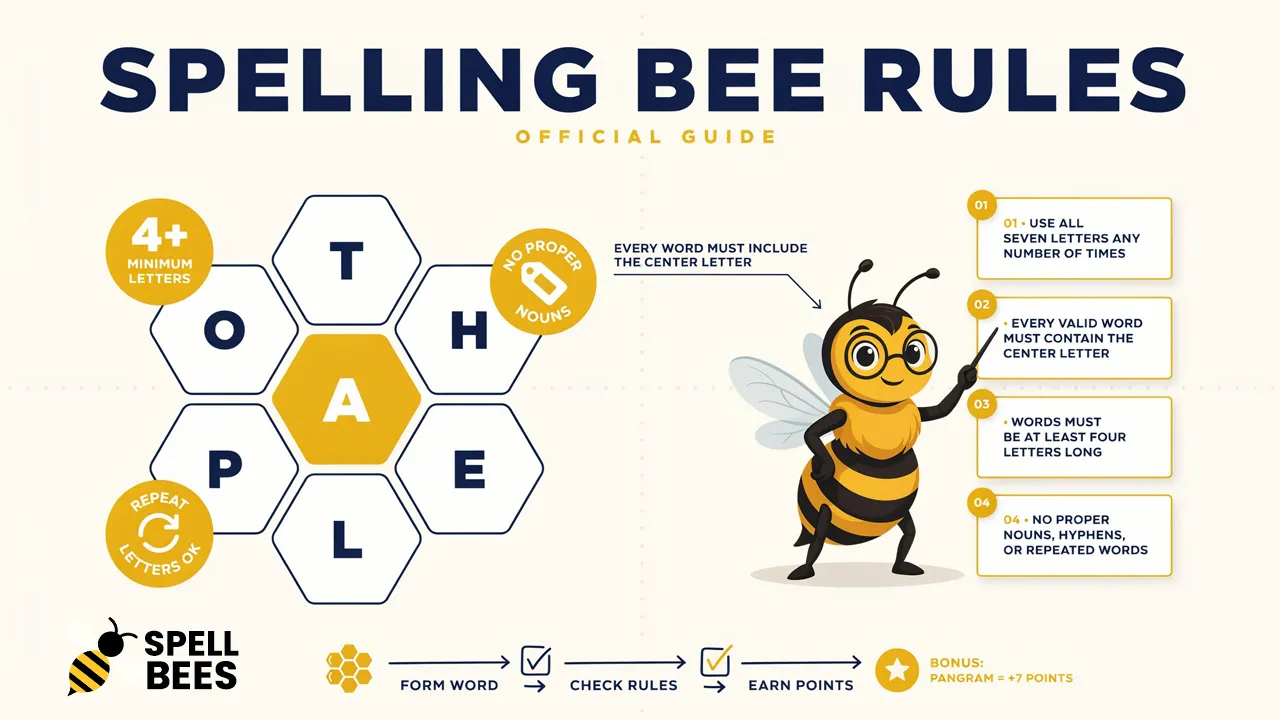
Each day, a new puzzle is published featuring a honeycomb of seven letters, one letter in the center, six surrounding it. Players form words using only these seven letters with the following rules:
- ➥Every word must be at least 4 letters long
- ➥Every word must include the center letter at least once
- ➥Letters can be used more than once in a single word
- ➥Proper nouns, hyphenated words, and obscene words are excluded
- ➥Words must appear on the NYT's internal accepted word list
NYT Spelling Bee Scoring System
| Word Length | Points Awarded |
|---|---|
| 4 letters | 1 point |
| 5 letters | 5 points |
| 6 letters | 6 points |
| 7 letters | 7 points |
| 8+ letters | 1 point per letter |
| Pangram (all 7 letters used) | Base points + 7 bonus points |
NYT Spelling Bee Ranking Levels
As you accumulate points, your status advances through levels the NYT displays above your word list:
| Rank Level | Progress |
|---|---|
| Beginner | Just starting out |
| Good Start | A few words found |
| Moving Up | Building momentum |
| Good | Solid progress |
| Solid | Above average |
| Nice | Getting impressive |
| Great | Strong performance |
| Amazing | Near the top |
| Genius | ~70% of total points, most players' goal |
| Queen Bee 👑 | Every possible word found |
What Is a Pangram in NYT Spelling Bee?
A pangram in the NYT Spelling Bee is any word that uses all seven letters at least once. Every daily puzzle contains at least one pangram. Finding the pangram typically unlocks a golden honeycomb animation. Some puzzles contain multiple pangrams, which the NYT calls "perfect pangrams" when a word uses each of the seven letters exactly once. For a deeper breakdown of pangram strategy, see the spelling bee pangram guide on this site.
NYT Spelling Bee: What Is NOT Allowed
- ➥Words shorter than 4 letters
- ➥Words that do not contain the center letter
- ➥Proper nouns (names of people, places, brands)
- ➥Hyphenated words
- ➥Offensive or obscene words
- ➥Words not on NYT's internal accepted list (even if in standard dictionaries)
The NYT word list is proprietary and intentionally does not match any standard published dictionary. Valid dictionary words are sometimes rejected, and occasionally obscure words are accepted. The NYT list is simply its own curated collection, this is a common source of frustration for daily players.
School-Level Spelling Bee Rules: What Changes at Local Competitions
School and district bees adapt Scripps guidelines to fit smaller groups, limited resources, and educational contexts. Here is what commonly changes:
| Rule Element | Scripps Standard | Typical School Adaptation |
|---|---|---|
| Word Source | Merriam-Webster Unabridged | Official Scripps School Competition List |
| Preliminary Format | Written rounds | Oral only (all rounds) |
| Time Limit | 20–30 seconds | Often more flexible |
| Vocabulary Round | Yes (advanced levels) | Rarely included |
| Spell-Off | 90 seconds | May use simple "continue until someone wins" |
| Bell for Misspelling | Official bell used | Teacher verbal correction |
| Written Appeals | Formal process | Teacher / judge discretion |
For students preparing for school-level competitions, the most practical approach is to work through the Scripps School Competition List words rather than memorizing from a general dictionary. Your teacher or competition organizer can provide access to the current year's list. You can also start building vocabulary now using the master spell bee spellings resource on this site.
Rules Variations: International and Regional Competitions
Pakistan Spelling Bee (PSB) Rules
The Pakistan Spelling Bee uses a distinctly different format from Scripps that many international students need to understand before competing.
The Say-SPELL-Say Formula: Every contestant must say the word, spell it letter by letter, then say the word again at the end. Failing to follow this formula, even with a correct spelling, results in zero points for that word.
Team Format: PSB competitions are primarily team-based. Two students represent each school. One nominated speller answers per word, but the team has 20 seconds to confer before spelling begins.
PSB Scoring System (Not Elimination-Based)
| Outcome | Score |
|---|---|
| Correct spelling + Correct procedure | +2 |
| Correct spelling + Incorrect procedure | 0 |
| Incorrect spelling + Correct procedure | −1 |
| Incorrect spelling + Incorrect procedure | −1 |
| No answer given | −1 |
Filler Sound Rule: Any "um," "uh," or "ah" inserted while spelling the word counts as incorrect procedure and results in zero points. This is strictly enforced and catches many contestants off guard.
Both British and American spellings are accepted in the English language PSB competition, unlike Scripps, which accepts American spellings only.
Drunk Spelling Bee Rules
Drunk spelling bees are adult social events, pub trivia variants, with no official governing body. Common rules used in bars and social events:
- ➥Contestants spell words after completing a drinking challenge
- ➥Standard elimination format: one misspelling = out
- ➥Words are often chosen for humor value, long, obscure, or deliberately tricky
- ➥Time limits are loose, usually 30 seconds with crowd tolerance
- ➥Audience participation and heckling are often encouraged
There are no official rules for drunk spelling bees. If you are running one, adapt standard competition elimination rules, remove the strict timer, and select words that are entertaining when mispronounced.
Other Regional Variations
- ➥Brookline Schools (USA): Enforce a 20-second time limit; contestants must face judges while spelling
- ➥Roseburg District: Words are pronounced strictly according to diacritical markings
- ➥Regional Competitions: May use customized tie-breaking systems or replay rounds
- ➥International Competitions: Often adapt rules to support different languages, writing systems, or cultural contexts
Competition Rules Comparison: Scripps vs NYT vs School vs PSB
| Rule | Scripps National | NYT Puzzle | School-Level | Pakistan Spelling Bee |
|---|---|---|---|---|
| Format | Oral, elimination | Digital, solo | Oral, elimination | Team, scored rounds |
| Time Limit | 20–30 seconds | No limit | 20–30 sec (flexible) | 40 seconds total |
| One Mistake = Out? | Yes | No | Yes | No (scoring system) |
| Ask for Definition? | Yes | No | Yes | First 20 sec only |
| Dictionary | Merriam-Webster Unabridged | NYT internal list | Scripps School List | Oxford / Merriam-Webster |
| Vocabulary Round | Yes (national level) | No | Rarely | No |
| Pangrams | Not applicable | Yes, bonus points | Not applicable | Not applicable |
| Tiebreaker | 90-second spell-off | Not applicable | Varies | SpellTok game |
| British Spellings | No, American only | No | No | Yes, both accepted |
| Age Limit | Under 15, Grade 8 max | None | Varies by school | Varies by grade category |
How to Prepare: Strategies That Work Under Actual Competition Pressure
Understanding the rules is only half the preparation. Here is how to apply that knowledge effectively and consistently.
Study Word Origins Before Word Lists
Before you memorize any word list, spend time learning the most common root languages in English spelling bee competitions. Greek roots explain "pneumonia" (the silent P), "psychology" (the silent P again), and "phenomenon." Latin roots explain why "conscience" has a silent C. French origins explain why "restaurant" ends in "-ant" rather than "-ent."
This approach separates contestants who memorize from contestants who understand. Understanding generates correct spellings for words you have never seen before, which is exactly what high-level rounds require.
Practice the Requests Strategically
Most contestants waste their question allowance by asking for things they already know. Use the request system with intention:
- ➥Ask for language of origin when you do not recognize the word's structure
- ➥Ask for definition when the word sounds like it could have two different spellings based on meaning
- ➥Ask for part of speech when a word could be both a noun and a verb spelled differently
- ➥Ask for a sentence when context might confirm whether it is a British-origin or American-origin word
Simulate Spell-Off Conditions
Even if you never reach a national final, practicing rapid-fire spelling builds recall speed that benefits every round. Set a 90-second timer and spell words continuously from a list. Track how many you complete correctly. Aim to reach 12–15 correct words in 90 seconds at competition-level difficulty.
Train for Timed Rounds
Set a 25–30 second timer for every practice word. Do not allow yourself to exceed it. This exercise improves focus, listening, and quick decision-making, skills that are impossible to build without actually practicing under time pressure. The unlimited spelling bee mode on this site lets you build this habit in a structured environment.