
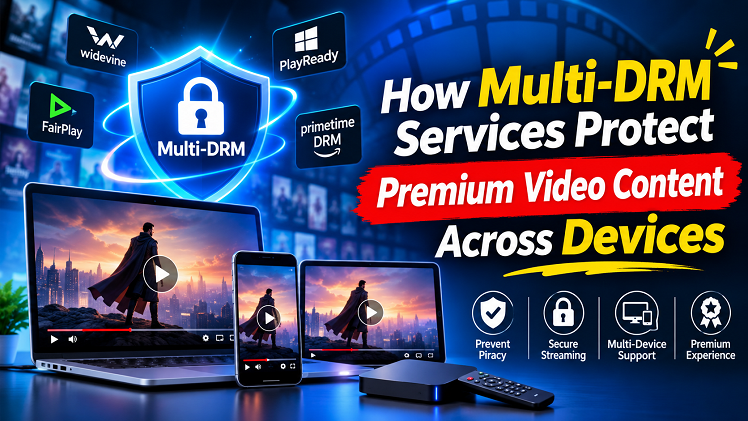
Premium video content is distributed through websites, mobile applications, smart televisions, and over-the-top platforms. Each playback environment may rely on a different digital rights management system.
A multi DRM service brings support for several DRM technologies into a coordinated content protection process, helping providers manage licensing and deliver protected video across a broad range of devices. Understanding how packaging, encryption, license requests, and client integration work together explains why this approach is important for premium streaming.
Why Multiple DRM Technologies Are Needed
A service must coordinate packaging, license requests, and playback rules across its supported devices. A unified process brings these tasks together when the same catalog is offered through different client types.
Viewers may use a computer browser, phone application, or connected television. These environments do not all use the same DRM technology. Supported systems include PlayReady, Widevine, FairPlay, Huawei WisePlay, and NCG.
Supporting several DRM standards lets a content service address different client environments through one coordinated licensing arrangement.
Understanding the Main DRM Technologies
Each DRM system is associated with particular client environments. Google Widevine is used across Android and supported browsers and connected devices. Apple FairPlay Streaming supports Apple playback environments, including iOS, macOS, Safari, and tvOS. Microsoft PlayReady is used with Windows environments and supported smart televisions and OTT devices.
Huawei WisePlay and NCG extend the range of supported options. The appropriate technology depends on the playback platform and the service’s integration requirements.
Content Packaging Creates the Protected Stream
Content packaging is an essential stage in securing premium video before distribution. It prepares original media files for protected playback by converting them into encrypted streaming formats compatible with different DRM technologies. Depending on the target platform, providers can use DASH or HLS packaging to support different playback requirements.
For example, CENC packaging supports DASH content for PlayReady, Widevine, and Huawei WisePlay, while AES-128 packaging supports HLS content for FairPlay Streaming. NCG supports encrypted MP4 and HLS output. Packaging can be managed through dedicated packagers, command-line tools, APIs, or integrated third-party solutions.
The process also supports video-on-demand and live content through file-based preparation or encoder and transcoder integrations. Encryption keys can be managed through cloud-based options or supplied using an external key input method. These capabilities help content providers prepare protected media for delivery across supported devices and streaming environments.
License Management Controls Playback
A license request may originate from the client or pass through a proxy in the service backend. This choice lets the provider align the request path with its own service architecture. The licensing workflow is therefore not limited to a single integration pattern, and the use of tokens provides an authentication method for requests before the player receives permission to play protected media.
Encryption protects the media, while a DRM license gives a compatible player permission to decrypt and play it. When playback starts, the client sends a license request. It can request directly using an authentication token generated by the service backend, or send the request through a proxy license server.
The license server processes the request and issues the license needed for playback. License rules can be configured for streaming or downloads, including Download to Own and Download to Rent arrangements. Other settings can address external display output, HDCP application, and rooting or jailbreaking. These controls help a content provider apply playback conditions according to its service requirements.
Token authentication and external key input options help the licensing process fit different customer environments. These options support integration with different customer service architectures.
Client Integration Connects Devices to Protection
Chrome, Edge, Safari, and Firefox are among the supported browsers. Providers can use client SDKs or integrate with native playback components and license APIs, selecting a method suited to the device and its DRM standard.
Client integration connects each playback application with the license service. APIs, client SDKs, documentation, and samples are available for supported platforms.
Supported environments include major browsers such as Chrome, Edge, Safari, and Firefox on Windows, Android, macOS, and iOS. Mobile applications for Android and iOS are also supported. The range extends to OTT platforms and connected televisions, including Android TV, Fire TV, tvOS, Tizen TV, webOS TV, and Roku. Other client platforms can be supported when they natively support the relevant multi-DRM technology.
Native integration can use Media3 ExoPlayer and Android MediaDrm on Android, or AVPlayer on iOS and tvOS. OTT devices and smart televisions use their platform-specific integration methods.
Supporting Different Delivery and Viewing Needs
License rules can cover streaming and downloads, while packaging supports on-demand files and live channel content.
A cloud-based licensing service runs on Amazon Web Services and offers callback gateway integration or token-based license APIs.
These options help content providers manage different delivery requirements while maintaining DRM protection throughout the playback process. Providers can select supported integration methods according to their existing content services and target client environments.
A Connected Workflow from Packaging to Playback
The workflow has linked stages. Original content is packaged and encrypted, license issuance is integrated into the service backend, and the player is connected to the license request flow. Protected content is then distributed, with the cloud license service handling requests from supported devices.
Packaging prepares media, encryption protects it, licensing governs access, and client integration enables playback. Together, these stages support delivery across browsers, mobile devices, and television platforms.
Conclusion
Premium video protection depends on more than encrypting a media file. Content packaging, key management, license rules, authentication, and device integration must work together. Supporting several DRM standards helps streaming providers address varied playback environments while managing access through a unified workflow. A well-integrated multi DRM service helps bring these protection stages together, supporting secure delivery of premium video across devices and viewing formats.
Protecting premium video requires reliable technology, flexible integration, and effective access management across devices. Doverunner offers advanced content security solutions designed to protect premium video content through Multi-DRM licensing, secure packaging, and flexible integration options. Supporting technologies such as Widevine, FairPlay, PlayReady, Huawei WisePlay, and NCG, DoveRunner’s solutions help streaming providers manage content access across different devices and platforms. Explore DoveRunner’s content protection capabilities to strengthen digital rights management and secure video distribution.